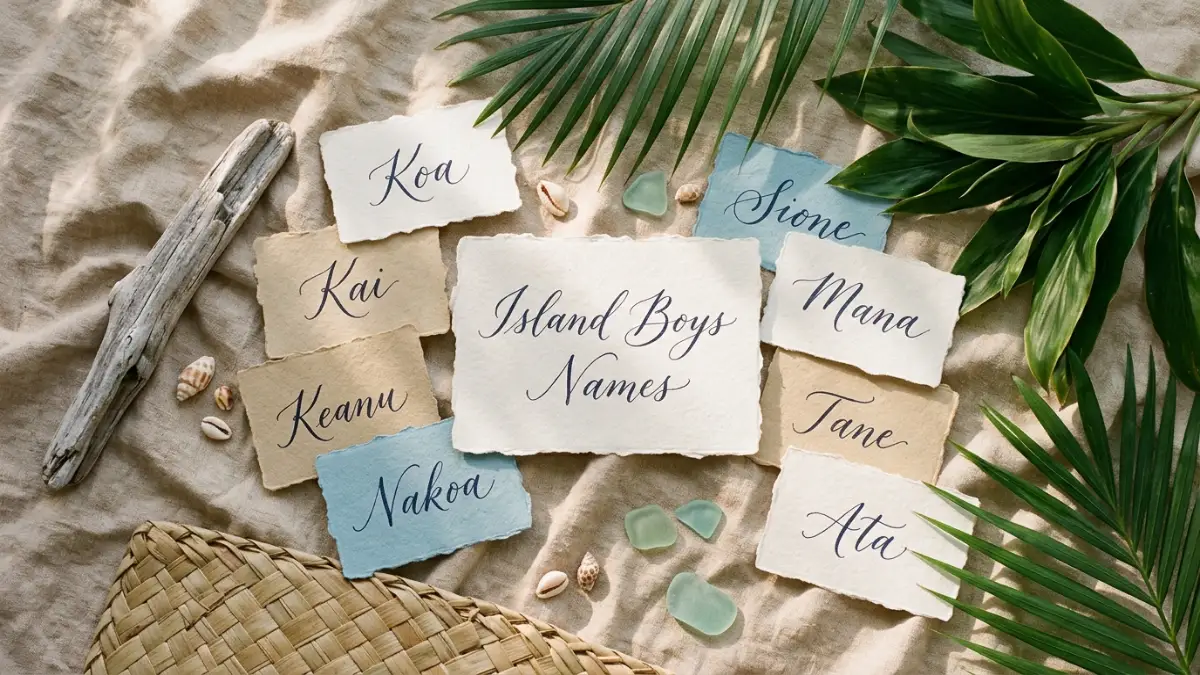
There is something instantly captivating about an island name. It can bring to mind salt air, turquoise water, palm-lined shores, volcanic mountains, warm sunsets, and a life that feels a little freer.
But choosing island boys names is about more than finding something that sounds tropical. Some parents want a genuine Hawaiian or Polynesian name. Others want a Caribbean feel, a strong ocean connection, or simply a name that carries that relaxed, adventurous island energy.
The best choices balance beauty with real meaning and cultural context. Below, you’ll find carefully selected names ranging from authentic Pacific and Hawaiian choices to internationally familiar names with a strong coastal or island aesthetic.
Quick Answer: What Are Good Island Boys Names?
Good island-inspired boy names include Kai, Koa, Nalu, Keanu, Kaleo, Kaimana, Makai, Ikaika, Moana, Mana, Tāne, Tane, Sione, Koa, Rio, Cruz, Finn, Ocean, Marley, and Zion.
For an authentic island connection, Hawaiian and Māori names such as Kai, Koa, Nalu, Keanu, Kaleo, Makai, Ikaika, and Tāne are especially interesting. For a broader tropical aesthetic, names such as Rio, Ocean, Cruz, Finn, and Marley can create a relaxed coastal feeling without claiming a specific island culture.
Important: “Island” is not one naming tradition. Hawaiian, Māori, Samoan, Tongan, Caribbean, and other island cultures have distinct languages and histories. A name should be appreciated in its actual cultural context rather than treated as interchangeable tropical decoration.
Best Island Boys Names at a Glance
| Name | Meaning / association | Origin | Vibe |
| Kai | Sea | Hawaiian; also used in several other languages with different origins | Minimal, oceanic |
| Koa | Warrior; brave | Hawaiian | Strong, adventurous |
| Nalu | Wave, surf | Hawaiian | Natural, relaxed |
| Keanu | The cool breeze | Hawaiian | Gentle, atmospheric |
| Kaleo | The voice, sound | Hawaiian | Musical, warm |
| Makai | Toward/at the sea | Hawaiian | Coastal, modern |
| Ikaika | Strong, powerful | Hawaiian | Bold, energetic |
| Kaimana | Hawaiian compound associated with sea/ocean + power | Hawaiian | Oceanic, distinctive |
| Moana | Ocean | Polynesian languages; also a Māori/Hawaiian word | Expansive, natural |
| Tāne | Māori deity associated with forests | Māori | Ancient, earthy |
| Sione | Tongan form of John | Tongan | Traditional, warm |
| Mana | Spiritual power/authority | Polynesian usage, including Māori | Powerful, distinctive |
| Rio | River | Spanish/Portuguese word/name | Bright, international |
| Cruz | Cross | Spanish/Portuguese | Stylish, compact |
| Ocean | Ocean | English nature name | Modern, free-spirited |
| Finn | Irish-associated name | Irish | Adventurous, familiar |
| Marley | English surname/place name | English | Musical, laid-back |
| Zion | Biblical place name | Hebrew/Biblical | Spiritual, modern |
The first group has stronger direct links to Pacific languages or island cultures. The latter names are better understood as island-inspired or coastal choices, rather than traditional island names.
Hawaiian Island Boys Names
Among the most natural choices for island boy names are Hawaiian names. Hawaiian is a living Polynesian language with its own pronunciation patterns, vocabulary, and naming traditions.
Kai
Meaning: Sea
Origin: Hawaiian; also independently found in other naming traditions
Gender: Commonly unisex in modern use
Pronunciation: Usually similar to “kye”
Kai is perhaps the cleanest island-inspired choice. Its short spelling and direct association with the sea give it a strong coastal identity without feeling elaborate.
Its modern appeal is also international. Kai works equally well for a baby, teenager, or adult, which gives it excellent long-term usability.
Vibe: Minimalist, oceanic, confident, modern.
Nicknames: Usually unnecessary because of its short length.
Similar names: Koa, Nalu, Cove, Finn, Kaius.
Koa
Meaning: Warrior, brave
Origin: Hawaiian
Gender: Traditionally associated with masculine naming; modern usage can vary
Koa has a completely different energy from Kai. Rather than softness and water, it suggests courage and strength.
The word koa also refers to the Hawaiian koa tree, an important native tree, adding a strong connection to the natural landscape of Hawaiʻi.
Vibe: Strong, rugged, outdoorsy, noble.
Best for: Parents who want an island name with masculine strength rather than an overtly nautical sound.
Similar names: Koa, Koa’i, Ikaika, Kai.
Nalu
Meaning: Wave, surf
Origin: Hawaiian
Gender: Often used as a masculine given name, though modern usage may vary
Nalu feels almost like the sound of the ocean itself. It is particularly appealing for families who connect with surfing, beaches, or water.
Unlike a generic English nature name, Nalu has a specific Hawaiian linguistic connection.
Vibe: Surf culture, carefree, artistic, natural.
Nicknames: Nal.
Similar names: Kai, Makai, Kaimana, Moana.
Keanu
Meaning: Commonly understood from Hawaiian elements as “the cool breeze”
Origin: Hawaiian
Gender: Masculine
Keanu has a soft, cinematic quality. Its association with a cool breeze gives it an especially atmospheric island feeling.
The name is also internationally recognizable because of actor Keanu Reeves, who was born in Honolulu and has Hawaiian heritage.
That association gives Keanu an unusual advantage: it feels culturally connected while remaining familiar outside Hawaiʻi.
Vibe: Calm, thoughtful, handsome, sophisticated.
Similar names: Koa, Kaleo, Kai, Keoni.
Kaleo
Meaning: The voice, sound
Origin: Hawaiian
Gender: Masculine
Kaleo is an excellent choice for parents who want something musical. Its meaning makes it especially fitting for a child whose family connects with music, storytelling, or performance.
It has more syllables than Kai or Koa, but remains easy to say once learned.
Vibe: Artistic, expressive, warm, soulful.
Nicknames: Leo can be used informally, although it is not the same name etymologically.
Makai
Meaning: Toward or at the sea
Origin: Hawaiian
Gender: Used as a masculine given name in modern naming
Makai feels distinctly coastal. In Hawaiian, mākaʻi and maka‘i can have other meanings depending on spelling and context, so the exact orthography matters; the commonly used name Makai is associated with the sea through Hawaiian kai.
It has a modern surname-like quality that appeals to parents looking beyond more familiar Kai.
Vibe: Coastal, contemporary, adventurous.
Ikaika
Meaning: Strong, powerful
Origin: Hawaiian
Gender: Masculine
Ikaika offers a different interpretation of island masculinity. Instead of directly referencing the ocean, it expresses strength.
The repeated vowel sounds also give the name a distinctly Polynesian linguistic character.
Vibe: Powerful, athletic, fearless.
Similar names: Koa, Keanu, Kaleo.
Kaimana
Meaning: Often interpreted through Hawaiian elements as a combination associated with “sea” and “power”
Origin: Hawaiian
Gender: Masculine usage
Kaimana has a grander, more dramatic sound than Kai. It works particularly well for parents who want a distinctly oceanic name without choosing an obvious English word such as Ocean.
Because Hawaiian compound names and meanings depend on actual linguistic construction and context, it is better to describe Kaimana’s interpretation carefully rather than treating “power of the sea” as a fixed traditional dictionary translation.
Vibe: Majestic, tropical, distinctive, adventurous.
Māori Island Boys Names
New Zealand’s Māori naming tradition offers another rich source of names with strong connections to the Pacific.
Tāne
Meaning: Tāne is a major figure/deity in Māori tradition, particularly associated with forests and life.
Origin: Māori
Gender: Masculine
Tāne is much more than an “island-sounding” name. It carries genuine cultural and mythological significance in Māori tradition.
The macron is important in written Māori because vowel length can affect pronunciation and meaning. Tāne should therefore not casually be stripped of its macron when presenting it as the Māori name.
Vibe: Ancient, earthy, powerful, spiritual.
Mana
Meaning: A concept of spiritual power, authority, prestige, or influence
Origin: Widely present across Polynesian languages, including Māori
Gender: Modern naming usage varies
Mana is an important Polynesian concept rather than simply a decorative “tropical” word. Its meaning and usage can differ between cultures and languages.
As a name, it feels short, commanding, and memorable.
Vibe: Powerful, spiritual, minimalist.
Important: Because mana has deep cultural significance, it is worth understanding the tradition behind the word before using it solely for its aesthetic appeal.
Pacific Island Boys Names With Traditional Roots
Pacific Island cultures extend far beyond Hawaiʻi and Aotearoa New Zealand. Samoa, Tonga, Fiji, and other island communities each have their own languages and naming practices.
Sione
Meaning: A Tongan form of John
Origin: Tongan
Gender: Masculine
Sione demonstrates why island naming should not be reduced to ocean-related vocabulary.
It is a culturally established Christian name form in Tonga rather than a word meaning “sea” or “beach.”
Vibe: Traditional, friendly, warm, dignified.
Iosefa
Meaning: Form related to Joseph
Origin: Used in Polynesian languages, including Tongan and other Pacific contexts
Gender: Masculine
Iosefa is a Pacific form connected to the biblical name Joseph. It illustrates how Christianity became incorporated into many Pacific naming traditions while local languages shaped the forms of familiar biblical names.
Vibe: Traditional, religious, culturally grounded.
Mika
Meaning: Forms related to Michael or Micah depending on language and tradition
Origin: Used across multiple cultures and languages
Gender: Varies by culture
Mika is especially interesting because it appears in several independent naming traditions. That makes it important not to assign one universal meaning or origin.
As a Pacific-inspired choice, it has a clean, international sound.
Vibe: Soft, modern, versatile.
Caribbean-Inspired Boys Names
The Caribbean contains dozens of cultures, languages, and naming traditions, so there is no single “Caribbean name style.”
English-, French-, Spanish-, Dutch-, and Creole-speaking communities all contribute to the region’s naming landscape. African heritage, biblical names, European surnames, Indigenous history, and contemporary global culture also influence Caribbean naming.
Marley
Origin: English surname/place-name tradition
Gender: Modern unisex usage
Marley has a relaxed island feeling partly because of its strong association with Jamaica and Bob Marley.
The important distinction is that Marley is not simply a traditional Jamaican first name meaning “island.” Its Jamaican cultural association is largely modern and popular-cultural.
Vibe: Musical, relaxed, warm, creative.
Zion
Origin: Hebrew/Biblical
Meaning: Biblical place name associated with Jerusalem
Gender: Modern masculine usage, though usage can vary
Zion has become particularly recognizable in contemporary Caribbean and broader global culture, including reggae and Rastafari contexts.
Its history is biblical rather than inherently Caribbean, but its modern cultural associations can give it a powerful island-reggae aesthetic.
Vibe: Spiritual, bold, modern.
Kingston
Origin: English
Meaning: “King’s town” as an English place-name formation
Gender: Modern masculine usage
Kingston is strongly associated with Jamaica because of Kingston, the country’s capital.
It is best understood as a place-inspired name with Caribbean cultural resonance rather than an indigenous Jamaican given name.
Vibe: Urban island, confident, sophisticated.
Ocean-Inspired Island Boys Names
If your main goal is an island atmosphere rather than a culturally specific name, nature names can be a better fit.
Ocean
Meaning: The ocean
Origin: English word name
Gender: Modern unisex usage
Ocean is direct, expansive, and unmistakably coastal.
It has a modern nature-name quality and works particularly well as a first or middle name.
Vibe: Free, peaceful, adventurous.
Rio
Meaning: “River” in Spanish and Portuguese
Origin: Spanish/Portuguese word
Gender: Modern masculine usage in many contexts
Rio does not mean “island,” but its connection to water gives it an effortless tropical quality.
It is short, internationally recognizable, and easy to pair with longer middle names.
Vibe: Sunny, energetic, worldly.
Cove
Meaning: A small sheltered coastal inlet
Origin: English vocabulary name
Gender: Modern unisex usage
Cove is a particularly good choice if you want the feeling of an island without borrowing a culturally specific name.
It is quiet and understated rather than obviously tropical.
Vibe: Minimalist, peaceful, coastal.
Reef
Meaning: A ridge or formation in the sea
Origin: English nature word
Gender: Modern word-name usage
Reef feels more adventurous than Cove. It immediately suggests coral reefs, diving, tropical water, and marine life.
Vibe: Rugged, oceanic, unconventional.
Finn
Origin: Irish naming tradition
Meaning: Associated with the Irish name Fionn, traditionally connected with “fair” or “white”
Gender: Masculine
Finn is not an island name in the Pacific sense, but it works beautifully within an ocean-inspired naming set.
Its connection to Finn McCool/Fionn mac Cumhaill, the legendary Irish hero, also gives it a strong storytelling dimension.
Vibe: Adventurous, youthful, literary.
Strong Island Boys Names
Some parents want an island feel without choosing a soft or beachy name.
These options carry more strength:
- Koa — brave, warrior-like energy
- Ikaika — strength and power
- Tāne — mythological and earthy
- Zion — spiritual and commanding
- Kingston — confident and place-inspired
- Reef — rugged and unconventional
- Cruz — compact and stylish
- Kai — short but confident
- Kaimana — expansive and distinctive
- Marley — relaxed confidence
Cruz
Meaning: Cross
Origin: Spanish/Portuguese
Gender: Masculine usage is common, though modern usage varies
Cruz has a completely different origin from Hawaiian names, but its short form and Spanish-language heritage give it a warm coastal character.
It also benefits from a strong international pronunciation and spelling.
Vibe: Stylish, confident, Mediterranean/Latin coastal.
Soft and Beautiful Island Boys Names
If you imagine a name for a gentle, artistic, or easygoing boy, these have a softer emotional profile:
Keanu
Cool breeze imagery gives the name a calm atmosphere.
Kaleo
Its association with voice and sound makes it feel expressive and musical.
Kai
Tiny, clean, and strongly connected with the sea in Hawaiian.
Nalu
The wave association gives it a peaceful surf-inspired quality.
Rio
Bright and energetic without sounding overly formal.
Ocean
Dreamy, expansive, and contemporary.
Marley
Warm, musical, and relaxed.
These are especially attractive for parents who want an island name that feels peaceful rather than aggressively tropical.
Rare Island Boys Names
For parents who want something less familiar, consider:
| Name | Main association | Overall impression |
| Ikaika | Hawaiian strength | Powerful |
| Nalu | Hawaiian wave | Artistic |
| Kaimana | Hawaiian sea/power association | Majestic |
| Makai | Hawaiian coastal direction | Contemporary |
| Kaleo | Hawaiian voice/sound | Musical |
| Tāne | Māori tradition | Ancient |
| Iosefa | Pacific form of Joseph | Traditional |
| Sione | Tongan form of John | Warm |
| Reef | Ocean nature name | Rugged |
| Cove | Coastal nature name | Minimalist |
Rare does not always mean better. With culturally specific names especially, authenticity and correct pronunciation matter more than simply choosing something unfamiliar.
Island Names That Work Well With Modern Siblings
A beautiful name should also sound natural beside the names already in your family.
With Kai
- Kai & Luca
- Kai & Mila
- Kai & Leo
- Kai & Aria
- Kai & Noah
Koa
- Koa & Finn
- Koa & Isla
- Koa & Maeve
- Koa & Leo
- Koa & Eden
With Nalu
- Nalu & Kai
- Nalu & Rio
- Nalu & Arlo
- Nalu & Maya
- Nalu & Zion
Keanu
- Keanu & Elias
- Keanu & Mateo
- Keanu & Luca
- Keanu & Noah
- Keanu & Kai
A useful rule is to consider rhythm rather than matching themes too literally. Siblings do not need names that all mean “ocean,” “sun,” or “wave.”
How to Choose the Right Island Boy Name
Decide whether you want authentic or aesthetic
This is the most important question.
If you specifically want a Hawaiian name, research Hawaiian names rather than selecting any name that sounds tropical.
If you simply want the feeling of an island childhood, names such as Cove, Ocean, Reef, Rio, Finn, or Marley may fit better.
Think about pronunciation
Short names such as Kai, Koa, Rio, and Cruz are relatively straightforward internationally.
Longer names such as Ikaika may require more explanation outside their cultural context. That is not a disadvantage, but parents should be comfortable teaching the correct pronunciation.
Consider cultural respect
A culturally specific name deserves more than a quick internet definition.
Check:
- The actual language
- Correct spelling and diacritics
- Pronunciation
- Whether it is genuinely used as a personal name
- Cultural or religious significance
- Whether a supposed “meaning” is actually an internet-created interpretation
This is particularly important for Hawaiian and Māori names.
Test the full name aloud
Say the first name with the surname several times.
Try it in different situations:
“Kai, come here.”
“This is Koa.”
“Please welcome Nalu.”
A name can look beautiful on a screen but feel completely different when spoken naturally.
Think beyond the baby stage
Ask whether you can imagine the name on:
- A toddler
- A teenager
- A university student
- A professional
- An older man
Names such as Kai, Koa, Keanu, Finn, and Rio tend to have enough flexibility to grow with a child.
What About Lucky Numbers, Colors, and Zodiac Associations?
Baby-name websites often attach lucky numbers, gemstones, colors, or zodiac signs to names. These can be fun additions, but they are not scientifically established properties of a name.
For example, a naming guide might associate Kai with blue because of its ocean connection. That is an aesthetic interpretation, not a verified cultural rule.
The same applies to numerology. A name’s “lucky number” depends on the particular numerology system and spelling method being used.
For serious naming decisions, prioritize:
meaning → cultural accuracy → pronunciation → family fit → personal connection
Treat numerology, lucky colors, gemstones, and zodiac associations as entertainment rather than evidence.
Island Boys Names: Modern vs. Traditional
One useful way to narrow the list is to decide how traditional you want the name to feel.
| Style | Good choices |
| Modern minimalist | Kai, Koa, Rio, Cove |
| Traditional Pacific | Sione, Iosefa, Tāne |
| Hawaiian nature | Kai, Nalu, Kaimana |
| Strong | Koa, Ikaika, Tāne |
| Soft | Keanu, Kaleo, Kai |
| Ocean-inspired | Nalu, Kai, Ocean, Reef |
| Caribbean-inspired | Marley, Kingston, Zion |
| International | Kai, Finn, Rio, Cruz |
| Rare | Ikaika, Kaimana, Nalu, Makai |
| Modern luxury | Kai, Koa, Cruz, Rio |
This distinction matters because a name can sound island-inspired without actually originating from an island culture.
My Top 15 Island Boys Names
If I were narrowing the entire list for a modern naming shortlist, these would stand out:
- Kai — the strongest all-around ocean choice
- Koa — short, strong, and naturally distinctive
- Keanu — gentle, recognizable, and atmospheric
- Nalu — excellent for a genuine wave-inspired feeling
- Kaleo — artistic and warm
- Ikaika — powerful and culturally distinctive
- Kaimana — dramatic ocean energy
- Makai — contemporary coastal character
- Tāne — deeply rooted in Māori tradition
- Sione — a strong Tongan option
- Marley — relaxed Jamaican association
- Rio — international and bright
- Ocean — unmistakably nature-inspired
- Cove — subtle and modern
- Finn — adventurous with strong literary roots
Best overall: Kai
If you want one name that is short, memorable, ocean-connected, internationally usable, and easy to pair with many surnames, Kai is difficult to beat.
Best strong choice: Koa
Koa offers a more masculine, rugged energy while retaining a genuine Hawaiian connection.
Best rare choice: Ikaika
Ikaika is a compelling option when cultural authenticity and a powerful meaning matter more than universal familiarity.
Best soft choice: Keanu
Keanu brings a calm, breezy feeling and has a recognizable modern association through Keanu Reeves.
Frequently Asked Questions
What are the best Hawaiian boy names?
Some appealing Hawaiian choices include Kai, Koa, Nalu, Keanu, Kaleo, Makai, and Ikaika. Each has its own meaning and linguistic context, so they should not be treated as interchangeable “tropical names.”
What boy name means ocean?
Kai is associated with “sea” in Hawaiian, while Moana means “ocean” in Polynesian languages including Māori and Hawaiian contexts. Ocean is the direct English nature name.
What is a strong island boy name?
Koa and Ikaika are excellent choices. Koa is associated with warrior/bravery and the Hawaiian koa tree, while Ikaika means strong or powerful in Hawaiian.
What is a unique Hawaiian boy name?
Ikaika, Nalu, Kaimana, Makai, and Kaleo offer distinctive alternatives to more familiar choices such as Kai.
Is Kai an island name?
Kai is not exclusively an “island name.” In Hawaiian, kai means “sea,” while the same spelling also appears independently in other languages with different meanings and origins. Its Hawaiian meaning makes it especially popular in ocean-inspired naming.
What are some Caribbean-inspired boy names?
Marley, Kingston, and Zion can evoke Caribbean culture in different ways. However, their origins are not identical: Marley is an English surname with strong Jamaican cultural associations, Kingston is an English place name strongly associated with Jamaica, and Zion is biblical with important modern Caribbean cultural associations.
Are island-inspired names only suitable for boys from island cultures?
No. But there is an important distinction between choosing a nature-inspired name such as Ocean or Cove and adopting a culturally specific name such as a Hawaiian or Māori name.
If you choose a culturally specific name, learn its actual meaning, pronunciation, history, and context rather than selecting it simply because it sounds fascinating or tropical.
Final Thoughts
The best island boys names do more than sound tropical. They create an atmosphere.
Kai feels like open water. Koa carries strength. Nalu brings the rhythm of waves. Keanu feels like a cool breeze. Kaleo has a musical warmth, while Tāne reaches into Māori tradition and mythology.
For a broader coastal style, Rio, Ocean, Cove, Reef, Finn, Marley, and Cruz offer that same sense of freedom without pretending to belong to a single island culture.
Ultimately, choose the name whose story feels right for your family—not simply the one that sounds the most fascinating. A memorable name should still feel comfortable when the beach is a distant memory and your little island adventurer becomes an adult.