Quick Answer:
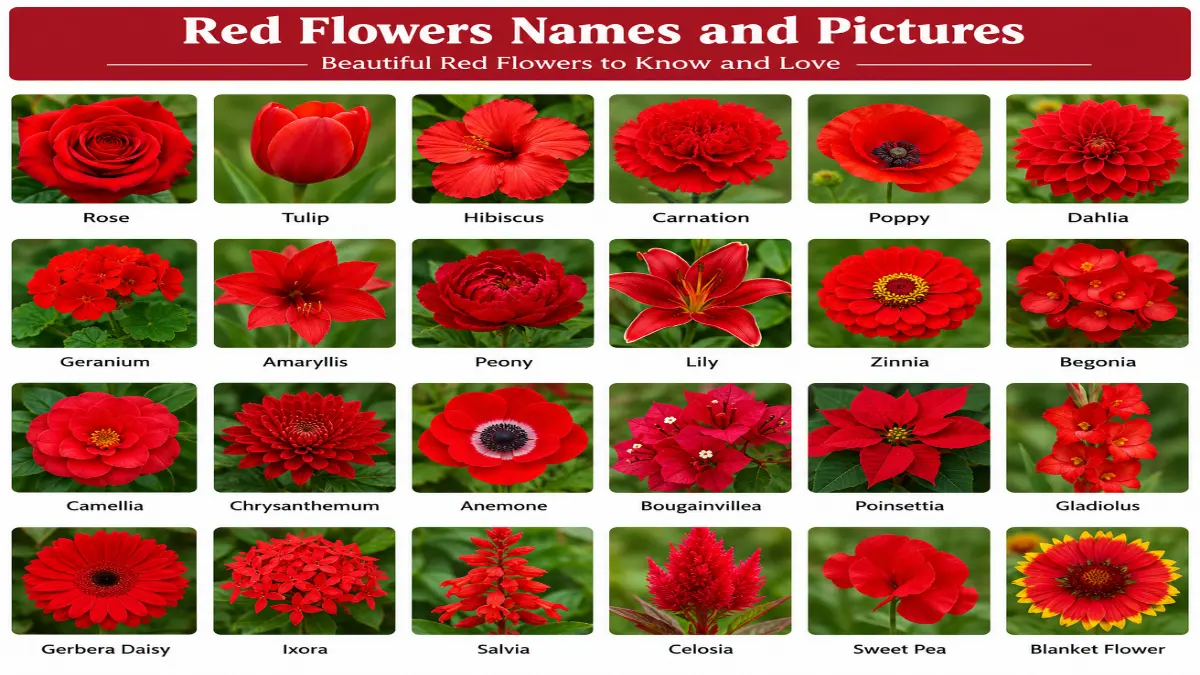
Some of the most recognizable red flowers include red rose, red tulip, red poppy, red dahlia, red carnation, red peony, red hibiscus, red camellia, red geranium, red zinnia, red begonia, red anthurium, and red chrysanthemum. Other possibilities include red ranunculus, red amaryllis, red gladiolus, red azalea, and red celosia.
Red flowers have a way of commanding attention. They can make a garden feel warmer, turn a bouquet into a statement, or add a dramatic touch to a character, username, project, or creative world.
But “red flower” covers far more than the classic rose. From velvety dahlias and fiery tulips to delicate poppies and tropical anthuriums, red blooms come in many shapes, shades, sizes, and growing habits.
This guide explores 50 red flower names, with practical details to help you recognize them and choose favorites. If you are looking for a flower for your garden, bouquet, photography, artwork, character, or simply want to know the names behind beautiful red blooms, you will find plenty of inspiration here.
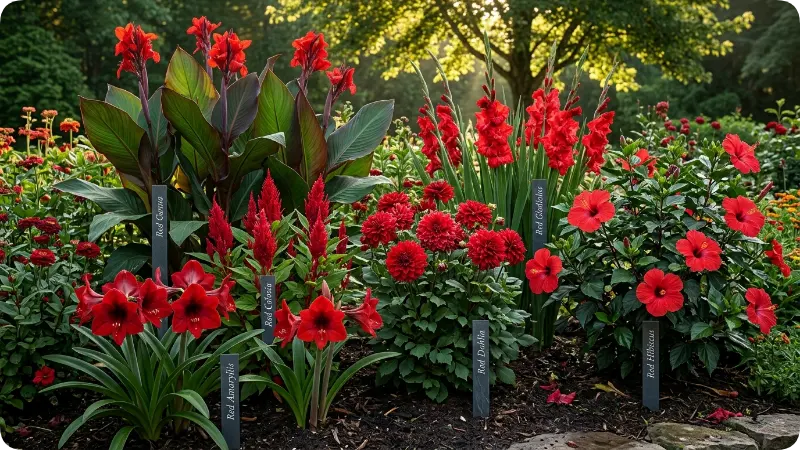
Red Flowers at a Glance
| # | Flower | Typical Red Form | Overall Vibe |
| 1 | Rose | Scarlet to crimson | Romantic, classic |
| 2 | Tulip | Bright red to deep red | Clean, cheerful |
| 3 | Poppy | Brilliant scarlet | Wild, delicate |
| 4 | Dahlia | Red and burgundy shades | Dramatic, luxurious |
| 5 | Carnation | Bright to deep red | Traditional, refined |
| 6 | Peony | Rich red shades | Lush, elegant |
| 7 | Hibiscus | Vivid red | Tropical, bold |
| 8 | Camellia | Crimson to deep red | Graceful, polished |
| 9 | Geranium | Strong red | Cheerful, classic |
| 10 | Zinnia | Scarlet and red shades | Bright, lively |
| 11 | Begonia | Red varieties | Decorative, versatile |
| 12 | Anthurium | Glossy red spathes | Tropical, modern |
| 13 | Chrysanthemum | Red cultivars | Full, sophisticated |
| 14 | Ranunculus | Red cultivars | Soft, layered |
| 15 | Amaryllis | Red trumpet flowers | Dramatic, statuesque |
| 16 | Gladiolus | Red cultivars | Tall, striking |
| 17 | Azalea | Red cultivars | Spring-like, colorful |
| 18 | Celosia | Red plume-like blooms | Sculptural, unusual |
| 19 | Red Salvia | Scarlet flowers | Vibrant, energetic |
| 20 | Red Petunia | Red cultivars | Casual, colorful |
| 21 | Red Snapdragon | Red cultivars | Playful, upright |
| 22 | Red Verbena | Red cultivars | Bright, spreading |
| 23 | Red Dianthus | Red cultivars | Sweet, compact |
| 24 | Red Impatiens | Red cultivars | Shady, cheerful |
| 25 | Red Nasturtium | Orange-red to red | Rustic, lively |
| 26 | Red Cosmos | Red cultivars | Airy, graceful |
| 27 | Red Coneflower | Red cultivars | Natural, bold |
| 28 | Red Daylily | Red cultivars | Strong, garden-friendly |
| 29 | Red Lily | Red cultivars | Dramatic, elegant |
| 30 | Red Calla Lily | Deep red cultivars | Sleek, sculptural |
| 31 | Red Alstroemeria | Red cultivars | Delicate, refined |
| 32 | Red Gerbera Daisy | Red cultivars | Sunny, expressive |
| 33 | Red African Violet | Red or reddish cultivars | Small, charming |
| 34 | Red Canna | Red cultivars | Tropical, powerful |
| 35 | Red Torch Ginger | Red inflorescences | fascinating, dramatic |
| 36 | Red Bromeliad | Red floral structures | Tropical, architectural |
| 37 | Red Bougainvillea | Red to magenta bracts | Tropical, vibrant |
| 38 | Red Firecracker Flower | Red tubular flowers | Bright, energetic |
| 39 | Red Fuchsia | Red floral combinations | Hanging, graceful |
| 40 | Red Phlox | Red cultivars | Soft, garden-like |
| 41 | Red Yarrow | Red cultivars | Rustic, textured |
| 42 | Red Bee Balm | Scarlet flowers | Wild, aromatic |
| 43 | Red Cardinal Flower | Brilliant scarlet | Striking, natural |
| 44 | Red Columbine | Red cultivars | Delicate, woodland |
| 45 | Red Bleeding Heart | Red cultivars | Romantic, unusual |
| 46 | Red Poinsettia | Red bracts | Festive, bold |
| 47 | Red Christmas Cactus | Red flowers | Seasonal, graceful |
| 48 | Red Erica | Red or reddish blooms | Delicate, unusual |
| 49 | Red Freesia | Red cultivars | Fragrant, elegant |
| 50 | Red Scabiosa | Red cultivars | Vintage, airy |
Availability of particular red shades varies by species, cultivar, growing conditions, and region.
Classic Red Flowers That Never Go Out of Style

Some red flowers are instantly recognizable. They appear in gardens, bouquets, paintings, celebrations, and photography because their shapes and colors are so distinctive.
1. Red Rose
The rose is perhaps the most recognizable red flower in the world. Red cultivars range from bright scarlet to deep crimson, with forms varying from tightly furled buds to large, layered blooms.
Vibe: Romantic and timeless
Best use: Bouquets, gardens, photography, classic floral themes
The rose is also useful when you need a flower-inspired name that feels immediately familiar. Rose, Rosie, Rosa, Rosalie, and Roselyn can all work as modern naming inspiration, although their meanings and linguistic histories differ and should not be treated as interchangeable.
2. Red Tulip
Red tulips have a simple, cup-shaped appearance that makes them especially recognizable. They work beautifully in spring gardens and colorful floral arrangements.
Vibe: Bright and clean
Best use: Spring gardens, bouquets, photography
For naming inspiration, Tulip has a softer, more unusual feeling than Rose, making it interesting for fictional characters or creative projects.
3. Red Poppy
Red poppies are famous for their delicate petals and dark centers. The field poppy, Papaver rhoeas, is especially associated with vivid scarlet flowers.
Vibe: Wild and delicate
Best use: Meadow-inspired themes, artwork, photography
Poppy is also an established personal name in English-speaking contexts, giving this flower a natural crossover into naming.
4. Red Carnation
Carnations have ruffled petals and are available in numerous colors, including strong reds. Their compact shape makes them popular in arrangements.
Vibe: Traditional and refined
Best use: Bouquets, floral arrangements, formal displays
5. Red Peony
Red peonies can create exceptionally full-looking blooms. Their layered petals give them a luxurious appearance when fully open.
Vibe: Lush and elegant
Best use: Gardens, bouquets, romantic photography
Peony can also work as a distinctive flower-inspired name, especially if you want something less common than Rose or Lily.
6. Red Chrysanthemum
Chrysanthemums come in many flower forms, from daisy-like blooms to dense decorative heads. Red cultivars can look especially rich and dramatic.
Vibe: Sophisticated and abundant
Best use: Gardens, floral displays, seasonal arrangements
Bold Red Flowers for a Dramatic Garden
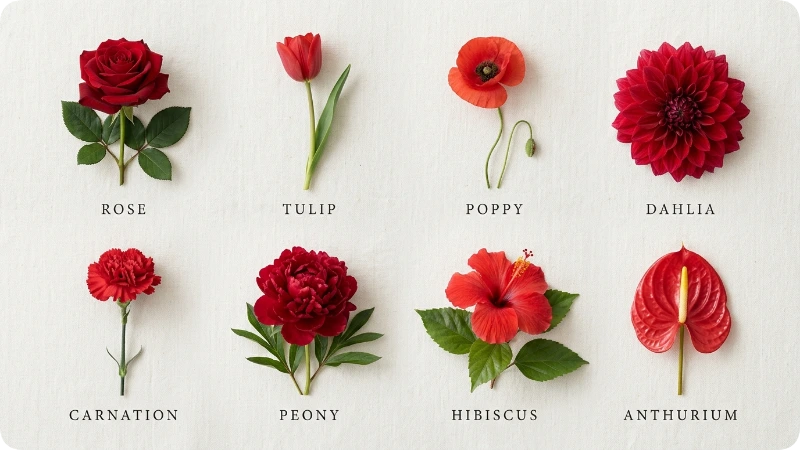
If your goal is visual impact, some red flowers have particularly strong silhouettes, unusual textures, or intense color.
7. Red Dahlia
Dahlias are known for their remarkable variety of forms and sizes. Red varieties can have tightly arranged petals, decorative layers, or more open structures.
Vibe: Dramatic and luxurious
Best use: Show gardens, bouquets, floral photography
8. Red Hibiscus
Hibiscus flowers often have large, prominent blooms and a distinctly tropical appearance. Red forms are particularly striking against green foliage.
Vibe: Tropical and bold
Best use: Warm-climate gardens, tropical photography
9. Red Amaryllis
Amaryllis produces large, trumpet-shaped flowers on tall stems. Red cultivars are especially popular for dramatic indoor displays.
Vibe: Statuesque and powerful
Best use: Indoor displays, seasonal decoration
10. Red Gladiolus
Gladiolus plants produce tall flower spikes lined with individual blooms. Red varieties create a strong vertical effect.
Vibe: Tall and commanding
Best use: Borders, cut flowers, floral arrangements
11. Red Canna
Canna plants have broad foliage and tropical-looking flowers. Red-flowering cultivars can give a garden an immediately fascinating appearance.
Vibe: Tropical and powerful
Best use: Statement planting, warm-climate gardens
12. Red Celosia
Celosia is especially memorable because some forms produce flowers resembling flames, feathers, or velvety crests.
Vibe: Sculptural and unusual
Best use: Creative gardens, dried arrangements, photography
Elegant Red Flowers for Bouquets and Names
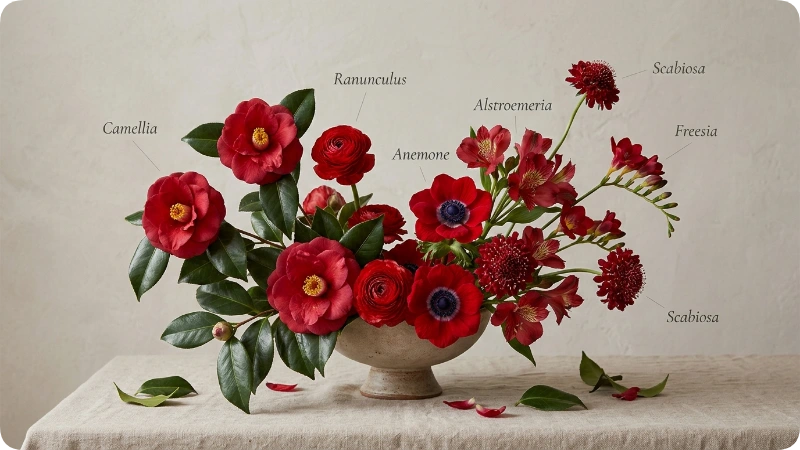
Not every red flower needs to look dramatic. Some have a softer, more polished appearance that works beautifully for floral arrangements and refined naming inspiration.
13. Red Camellia
Camellias have glossy foliage and beautifully structured flowers. Red cultivars can range from vivid to deep shades.
Vibe: Graceful and polished
Best use: Formal gardens, floral photography
Camellia is also a sophisticated flower-inspired name with an elegant sound.
14. Red Ranunculus
Ranunculus flowers have numerous thin petals arranged in layers, giving them a rose-like appearance with a distinct structure.
Vibe: Soft and layered
Best use: Weddings, bouquets, editorial photography
15. Red Anemone
Red anemones can have vivid petals surrounding a dark center, creating a high-contrast appearance.
Vibe: Artistic and striking
Best use: Photography, bouquets, creative gardens
16. Red Alstroemeria
Alstroemeria flowers have delicate, patterned petals and are commonly used as cut flowers.
Vibe: Refined and cheerful
Best use: Bouquets and arrangements
17. Red Freesia
Freesias are known for their fragrant flowers and elegant, arching stems. Red cultivars add a deeper visual note to their graceful form.
Vibe: Fragrant and elegant
Best use: Bouquets and indoor floral displays
18. Red Scabiosa
Scabiosa has rounded flower heads that can create a soft, almost pincushion-like texture.
Vibe: Vintage and airy
Best use: Cottage gardens, bouquets, photography
Unique Red Flowers With Unusual Shapes
If you want something beyond the familiar rose or tulip, these flowers offer distinctive forms and textures.
19. Red Anthurium
Anthuriums are known for their glossy, heart-shaped spathes and central spadix. Their polished appearance makes them popular in tropical and indoor settings.
Vibe: Modern and tropical
Best use: Indoor displays, contemporary photography
20. Red Bird of Paradise
The bird of paradise is famous for its unusual, bird-like flower structure. Its commonly seen flowers combine orange and blue, while related or cultivated forms can produce different visual effects.
Vibe: fascinating and sculptural
Best use: Tropical landscapes and botanical photography
Because flower color can vary by species, cultivar, and plant, it is better not to assume every bird-of-paradise flower is naturally pure red.
21. Red Torch Ginger
Torch ginger produces large, showy inflorescences that can look almost architectural.
Vibe: fascinating and dramatic
Best use: Tropical gardens and botanical photography
22. Red Bromeliad
Many bromeliads are valued for colorful foliage or floral structures. Some develop striking red centers or bracts.
Vibe: Architectural and tropical
Best use: Indoor plant displays and tropical gardens
23. Red Fuchsia
Fuchsia flowers are famous for their pendant, tubular forms and often contrasting petals and sepals.
Vibe: Hanging and graceful
Best use: Containers, baskets, shaded displays
24. Red Bleeding Heart
Bleeding heart plants are best known for heart-shaped flowers that hang from arching stems. Red or reddish forms exist, although color depends on species and cultivar.
Vibe: Romantic and unusual
Best use: Woodland-style gardens and botanical inspiration
Bright Red Flowers for a Cheerful Look
Some red flowers feel energetic rather than dramatic. They work especially well when you want a garden or bouquet to feel colorful and lively.
25. Red Geranium
Geraniums are popular ornamental plants, and red cultivars are especially recognizable in containers and window boxes.
Vibe: Cheerful and classic
Best use: Containers, balconies, garden beds
26. Red Zinnia
Zinnias are available in many colors and flower forms. Red varieties can create a strong splash of color during the growing season.
Vibe: Lively and youthful
Best use: Summer gardens and bouquets
27. Red Gerbera Daisy
Gerbera daisies have large, symmetrical flower heads and are popular as cut flowers.
Vibe: Sunny and expressive
Best use: Bouquets, photography, cheerful gardens
28. Red Petunia
Petunias are common ornamental flowers available in many colors. Red varieties are useful for containers and hanging baskets.
Vibe: Casual and colorful
Best use: Hanging baskets, containers, borders
29. Red Snapdragon
Snapdragons produce upright flower spikes with individual blooms along the stem.
Vibe: Playful and upright
Best use: Borders, cottage gardens, cut flowers
30. Red Verbena
Red verbena varieties can produce clusters of small flowers and are often used in containers and garden borders.
Vibe: Bright and spreading
Best use: Containers and low garden plantings
31. Red Impatiens
Impatiens are valued for their colorful flowers and suitability for many shaded garden situations, depending on the type.
Vibe: Soft and cheerful
Best use: Shade gardens and containers
32. Red Nasturtium
Nasturtiums produce rounded leaves and brightly colored flowers, with red and orange-red forms among the available varieties.
Vibe: Rustic and lively
Best use: Cottage gardens and edible-garden settings
Deep, Dark, and Mysterious Red Flowers
Red does not always mean bright scarlet. Burgundy, wine, crimson, and very deep red flowers can create a completely different atmosphere.
33. Red Lily
True lilies in the genus Lilium include cultivars with red or red-toned flowers.
Vibe: Dramatic and elegant
Best use: Borders, bouquets, formal gardens
The word Lily is also a widely recognized flower-inspired personal name.
34. Red Calla Lily
Calla lilies have a distinctive funnel-like or curved spathe surrounding the central spadix. Deep red cultivars can look almost sculpted.
Vibe: Sleek and sophisticated
Best use: Modern bouquets, photography, formal displays
35. Red Coneflower
Red coneflowers include cultivated varieties of Echinacea with red or reddish petals.
Vibe: Natural and bold
Best use: Pollinator-friendly garden designs and informal landscapes
36. Red Yarrow
Yarrow has flat-topped clusters of many small flowers. Cultivated forms are available in red shades.
Vibe: Rustic and textured
Best use: Cottage gardens and naturalistic planting
37. Red Bee Balm
Bee balm, particularly scarlet bee balm (Monarda didyma), is known for its tubular flowers arranged around the stem.
Vibe: Wild and energetic
Best use: Pollinator gardens and cottage-style landscapes
38. Red Cardinal Flower
Cardinal flower, Lobelia cardinalis, is known for intensely scarlet flowers arranged along tall stems.
Vibe: Striking and vivid
Best use: Moist garden areas and native-plant landscapes
Tropical and fascinating Red Flowers
Tropical flowers often stand out through unusual structures, glossy textures, or intense colors.
39. Red Bougainvillea
Bougainvillea is famous for its colorful papery bracts surrounding its small true flowers. Red and reddish cultivars are widely grown in suitable warm climates.
Vibe: Vibrant and tropical
Best use: Walls, fences, containers, warm-climate landscapes
40. Red Firecracker Flower
The name “firecracker flower” can refer to plants with bright tubular blooms, and common names may vary by region. Always check the botanical name when exact identification matters.
Vibe: Energetic and fascinating
Best use: Tropical themes and botanical inspiration
41. Red Poinsettia
Poinsettias are famous for their bright red bracts, especially during the winter holiday season. The small true flowers are located at the center.
Vibe: Festive and bold
Best use: Holiday displays and seasonal decoration
42. Red Christmas Cactus
Christmas cactus plants can produce colorful flowers, including red cultivars, during their seasonal blooming period.
Vibe: Festive and graceful
Best use: Indoor displays and holiday-inspired photography
More Red Flowers Worth Knowing
The following flowers give you even more options when you are building a garden, researching floral photography, or looking for unusual flower-inspired names.
43. Red Salvia
Scarlet sage, Salvia splendens, is widely grown as an ornamental bedding plant and is recognized for its upright spikes of vivid flowers.
Vibe: Energetic and vivid
Best use: Borders, containers, public landscapes
44. Red Daylily
Daylilies in the genus Hemerocallis are available in many colors and forms, including red cultivars.
Vibe: Strong and garden-friendly
Best use: Garden beds and landscape planting
45. Red Cosmos
Cosmos are generally associated with light, airy foliage and daisy-like flowers. Red and reddish cultivars exist, particularly among cultivated selections.
Vibe: Airy and graceful
Best use: Informal gardens and flower photography
46. Red Columbine
Columbines include species and cultivars with red flowers, sometimes combined with another contrasting color.
Vibe: Delicate and woodland-like
Best use: Cottage gardens and naturalistic planting
47. Red Phlox
Phlox includes several ornamental species and cultivars, some producing red or reddish flowers.
Vibe: Soft and garden-like
Best use: Borders and cottage gardens
48. Red Erica
Some plants in the genus Erica produce reddish or red-toned flowers. Exact flower color depends on the species or cultivar.
Vibe: Delicate and unusual
Best use: Botanical collections and specialized gardens
49. Red African Violet
African violets include cultivars with flowers ranging from purple and pink to red and reddish shades.
Vibe: Small and charming
Best use: Indoor plant collections
50. Red Azalea
Azaleas include many red-flowering cultivars. They are particularly valued for abundant seasonal blooms.
Vibe: Colorful and spring-like
Best use: Shrub borders, woodland gardens, landscape displays
Red Flower Names Inspired by Their Look
If you are searching for red flower names for a character, pet, username, artwork, fantasy world, or creative project, you do not have to use only botanical names.
A good approach is to choose a name based on the flower’s visual personality.
| Name Idea | Inspiration | Feeling |
| Rose | Red rose | Romantic, classic |
| Poppy | Red poppy | Playful, natural |
| Dahlia | Red dahlia | Dramatic, elegant |
| Camellia | Red camellia | Refined, graceful |
| Peony | Red peony | Soft, luxurious |
| Scarlet | Red color | Bold, vivid |
| Crimson | Deep red | Dark, powerful |
| Ruby | Red gemstone | Rich, brilliant |
| Ember | Glowing red | Warm, mysterious |
| Flame | Fiery red | Fierce, energetic |
| Garnet | Deep red gemstone | Regal, strong |
| Pomegranate | Red fruit | fascinating, vivid |
| Roselle | Flower/plant association | Soft, botanical |
| Poppyseed | Poppy-inspired | Whimsical |
| Cardinal | Red bird association | Striking, symbolic |
Names such as Scarlet, Crimson, Ruby, Ember, Flame, and Garnet are color or imagery-based creative choices rather than botanical names. That distinction matters if you are looking for a historically documented flower name.
Mythology, Culture, and Symbolism of Red Flowers
Red flowers have accumulated symbolism across different cultures, but there is no single universal meaning for every red bloom.
The red rose, for example, has a strong association with romantic love in many modern Western contexts. Its cultural symbolism developed over time through literature, art, social customs, and floral traditions rather than coming from one universal ancient source.
The red poppy has a particularly significant modern cultural association with remembrance of war in several countries, influenced by the poem In Flanders Fields and subsequent remembrance traditions.
The poppy also has much older cultural and mythological associations in different societies, but those traditions should not be collapsed into one generalized “poppy meaning.”
Other flowers have their own histories. Chrysanthemums, for instance, have deep cultural significance in East Asia, particularly China and Japan, where the flower has been cultivated and represented in art and tradition for centuries.
For this reason, it is better to research a flower by its scientific name, geographic context, and specific cultural tradition rather than assuming that every red flower has the same symbolic meaning.
How to Choose the Right Red Flower
With dozens of possibilities, the best red flower depends on what you actually want from it.
Match the Flower to the Mood
Choose a rose or peony if you want romance and softness.
For a dramatic look, consider a dahlia, calla lily, or gladiolus.
Choose a poppy, coneflower, yarrow, or bee balm for a more natural or wild feeling.
For a tropical atmosphere, consider hibiscus, anthurium, canna, torch ginger, or bougainvillea.
Think About Shape
Color is only half the story.
A rose has layered petals. A calla lily has a sleek curved form. Gladiolus creates a tall vertical line. Anthurium has a glossy, sculptural appearance.
If you are choosing flowers for photography, artwork, or a garden composition, shape can be just as important as color.
Consider Growing Conditions
A beautiful flower is not necessarily the right flower for your garden.
Before buying seeds or plants, check:
- Climate suitability
- Sunlight requirements
- Soil preferences
- Water needs
- Mature size
- Blooming season
- Hardiness for your region
- Whether the plant is annual, perennial, or grown as a houseplant
Common names can also cause confusion. When accuracy matters, check the botanical name on a reliable plant source or nursery label.
Think About Naming Potential
If you are choosing a red flower name for a character, pet, username, or creative project, listen to the name aloud.
Rose feels familiar.
Dahlia feels sophisticated.
Poppy feels playful.
Camellia feels elegant.
Crimson feels powerful.
Ember feels fiery and modern.
The best choice depends on the personality you want the name to communicate.
Check Pronunciation and Nicknames
Long botanical names can sound beautiful but may be less practical as everyday names.
For a character or pet, consider whether the name is easy to say and whether it naturally produces a nickname.
For example:
- Camellia → Cami
- Dahlia → Dali or Lia
- Poppy → Pop
- Rosalie → Rosie
- Amaryllis → Amy
These are creative nickname possibilities, not claims about official naming traditions.
Frequently Asked Questions
What is the most famous red flower?
The red rose is probably the most widely recognized red flower, particularly because of its strong presence in gardens, bouquets, art, literature, and romantic traditions.
What are some common red flowers?
Common examples include red roses, tulips, poppies, carnations, geraniums, zinnias, dahlias, petunias, hibiscus, chrysanthemums, begonias, and lilies.
What red flower is associated with remembrance?
The red poppy has a major remembrance association in several countries, particularly in connection with military service and those who died in war.
What are good red flower names for a character?
Rose, Poppy, Dahlia, Camellia, Peony, Scarlet, Crimson, Ruby, Ember, and Garnet can all work depending on the character’s personality and the style of the fictional world.
Which red flowers are good for bouquets?
Roses, carnations, peonies, ranunculus, dahlias, alstroemeria, gerbera daisies, lilies, and freesias are popular choices for floral arrangements, although suitability depends on the particular variety and availability.
Are all red flowers naturally red?
No. Some species naturally produce red flowers, while other red forms are specific cultivars or hybrids. Flower color can also vary from scarlet and crimson to burgundy, wine, orange-red, or reddish-purple.
Final Thoughts
Red flowers are far more diverse than the classic image of a red rose. Some are delicate and airy, while others are bold, tropical, sculptural, or richly layered.
If you are choosing a flower for a garden, begin with growing conditions and bloom style. For a bouquet, consider flower shape, season, and color balance. And if you are looking for a red flower name, think about the personality behind the name as much as the flower itself.
Whether you prefer the timeless Rose, the playful Poppy, the dramatic Dahlia, the graceful Camellia, or a less familiar bloom such as Cardinal Flower or Torch Ginger, there is a red flower to match almost every aesthetic.

I am Alexander Reed, a passionate Fantasy and Mythology Names Researcher and Content Writer at NamesHorizon.com. I share creative and well-researched content on fantasy names, mythology, magical creatures, and naming inspiration, helping readers discover distinctive names for characters, stories, and fictional worlds.