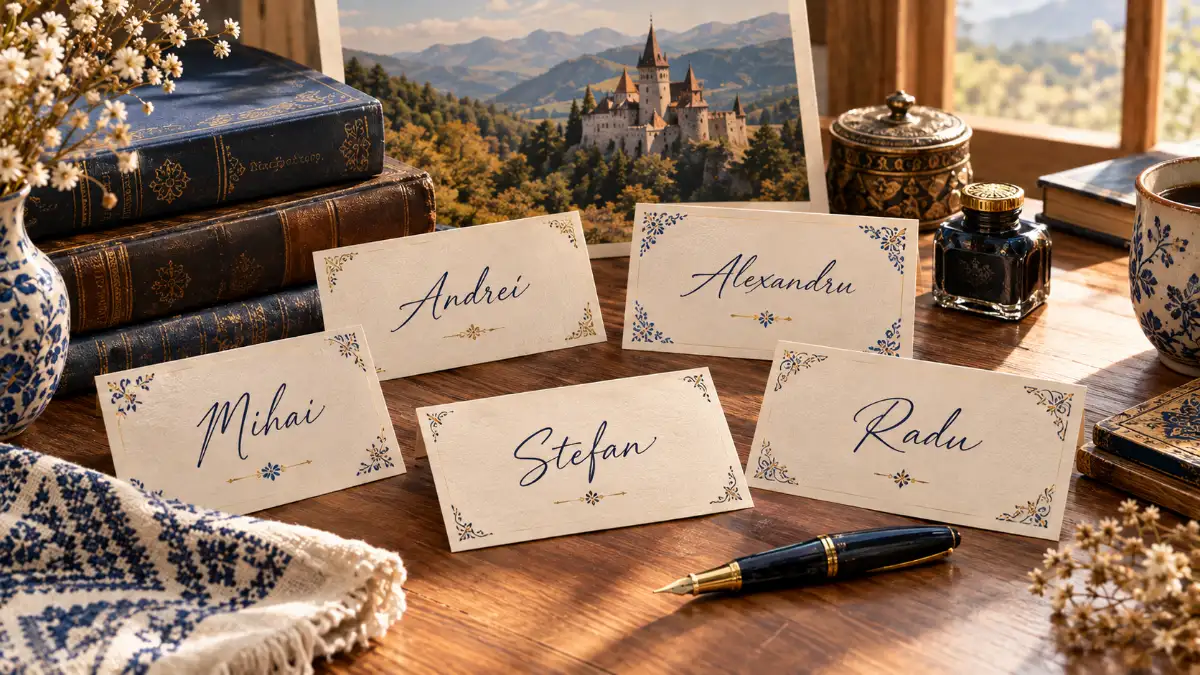
A good Romanian boy name can carry several layers at once: family history, Orthodox Christian tradition, Latin and Eastern European heritage, and a distinctly Romanian sound. Some names feel instantly familiar, like Andrei or Mihai. Others, such as Rareș, Dragoș, or Radu, have a more unmistakable Romanian character.
Whether you are naming a baby, creating a Romanian character, researching family heritage, or simply looking for a name with strength and elegance, the best choice depends on more than a dictionary meaning. Pronunciation, cultural context, nicknames, spelling, and the feeling a name creates all matter.
This guide explores Romanian male names from traditional classics to modern favorites, including their meanings, origins, pronunciation, personality impressions, and the kinds of families or characters they suit best.
Quick Answer: Popular Romanian Male Names
Romanian male names come from several linguistic and cultural traditions, including Romanian, Latin, Greek, Hebrew, and Slavic influences. Many traditional names are connected with Christianity, saints, medieval history, or older Eastern European naming traditions.
Some strong choices include:
| Name | Meaning / Origin | Pronunciation | Overall Feel |
| Andrei | Greek; related to andreios, “manly, brave” | an-DRAY | Warm, confident, classic |
| Alexandru | Greek; “defender of men” | ah-lek-SAN-droo | Strong, refined |
| Mihai | Romanian form related to Michael | mee-HIGH | Traditional, dignified |
| Ștefan | Greek; “crown, wreath” | SHTEH-fan | Noble, historic |
| Radu | Slavic; associated with “glad, willing” | RAH-doo | Distinctive, gentle |
| Vlad | Slavic naming tradition; associated with rule/power | VLAD | Bold, dramatic |
| Dragoș | Slavic; related to drag, “dear, beloved” | DRAH-gosh | Romantic, historic |
| Bogdan | Slavic; traditionally interpreted as “gift from God” | BOG-dan | Strong, meaningful |
| Matei | Romanian form of Matthew | mah-TAY | Soft, timeless |
| Rareș | Romanian historical name | RAH-resh | Rare, aristocratic |
| Tudor | Romanian traditional form related to Theodore | TOO-dor | Vintage, elegant |
| Nicolae | Greek; “victory of the people” | nee-ko-LIE-eh | Traditional, dignified |
Romanian pronunciation can differ noticeably from English pronunciation, so the original spelling and diacritics are worth preserving when cultural authenticity matters.
Traditional Romanian Male Names

Romanian naming traditions have been shaped by Christianity, the Eastern Orthodox tradition, Latin heritage, Slavic contact, and centuries of regional history. As a result, a Romanian name does not necessarily have to originate from the Romanian language to be deeply established in Romanian culture.
Andrei
Andrei is one of the most recognizable Romanian forms of Andrew. Its ultimate origin is Greek, from Andreas, related to andreios, meaning “manly” or “brave.”
The name feels friendly without becoming overly casual. It works especially well for parents who want something traditional but still natural for a child growing up in a modern international environment.
Nicknames: Andi, Andu
Style: Classic, warm, confident
Best for: A traditional first name with international familiarity
Alexandru
Alexandru is the Romanian form of Alexander and ultimately comes from Greek Alexandros, commonly interpreted as “defender of men.”
It has a substantial, formal sound, while nicknames such as Alex make it much more relaxed in everyday life.
Nicknames: Alex, Sandu
Style: Strong, elegant, established
Similar names: Alexander, Alessandro, Alexandre
Best for: Families wanting a formal full name with an easy nickname
Mihai
Mihai is the Romanian form related to Michael, from Hebrew Mikha’el, traditionally understood as “Who is like God?”
Its short structure gives it a clean, confident sound. Culturally, it feels unmistakably familiar in Romania while still being relatively easy for international speakers to recognize.
Nickname possibilities: Mihăiță, Mihai
Style: Traditional, masculine, dignified
Cultural relevance: Strongly established in Romanian Christian naming tradition
Ștefan
Ștefan comes from the Greek Stephanos, meaning “crown” or “wreath.” It is also closely associated with Christian tradition through Saint Stephen.
The Romanian Ș gives the name a particularly authentic local appearance. Without the diacritic, it may be written as Stefan in international contexts, although Ștefan is the Romanian spelling.
Style: Historic, noble, traditional
Aesthetic: Old-world, refined, scholarly
International form: Stephen, Stefan
Nicolae
Nicolae is the Romanian form of Nicholas, ultimately from Greek Nikolaos, traditionally interpreted as “victory of the people.”
The name has a distinctly traditional Romanian character. It can feel formal and dignified, particularly when paired with a shorter family nickname.
Style: Classic, serious, warm
Related names: Nicholas, Nikolai, Nikola
Best for: A heritage-rich traditional name
Strong Romanian Boy Names

Some names create an immediate impression of strength because of their sound, history, or cultural associations. That does not mean the name itself determines personality; rather, these are the names that often feel bold and substantial.
Vlad
Few names have a stronger visual identity than Vlad.
It is a short Slavic-origin name used in Romanian naming tradition and is particularly associated internationally with Vlad III, the historical ruler of Wallachia often called Vlad the Impaler.
That historical association has also influenced fictional vampire culture through the broader Dracula tradition. However, Vlad is a real Romanian given name independent of Dracula fiction.
Style: Dark, powerful, historic
Social impression: Confident and memorable
Aesthetic: Gothic, medieval, dramatic
International usability: Excellent
Radu
Radu has a much softer sound than Vlad, despite its historical depth. It is associated with Slavic naming elements connected with being glad, willing, or joyful.
Several historical rulers and members of Romanian princely families bore the name, giving it an old-world quality.
Style: Refined, gentle, historic
Personality vibe: Calm, intelligent, quietly confident
Aesthetic: Medieval European, understated luxury
Dragoș
Dragoș is a distinctly Romanian-feeling choice with Slavic linguistic roots. It is related to the Slavic element drag, meaning “dear” or “beloved.”
The name has a fascinating combination of softness and strength. Its sound is unusual to many English speakers, while remaining deeply familiar within Romanian culture.
Pronunciation: roughly “DRAH-gosh”
Style: Romantic, historic, masculine
Aesthetic: Medieval, Eastern European, distinctive
Bogdan
Bogdan is a Slavic name traditionally interpreted as “gift from God,” from elements associated with bog (“God”) and dan (“given/gift”).
It has long been used across several Slavic-language cultures and is also well established in Romania.
Style: Strong, meaningful, traditional
Religious connection: Traditional Christian interpretation
Personality vibe: Dependable, grounded, serious
Elegant and Refined Romanian Male Names

If you want a Romanian boy name that sounds polished rather than rugged, these choices have a more sophisticated character.
Sebastian
Sebastian ultimately comes from Greek Sebastianos, associated with sebastos, “venerable” or “revered.”
It is used internationally and fits naturally into Romanian naming culture. The name has a polished European quality without sounding overly formal.
Style: Elegant, international, cultured
Nicknames: Sebi, Seb
Best for: A Romanian name that travels easily across countries
Lucian
Lucian is related to the Roman family of names associated with Lucius, connected with Latin lux, “light.”
The name has a literary and intellectual feeling. It can suit someone looking for an old-fashioned name that still feels sophisticated.
Style: Literary, elegant, intelligent
Aesthetic: Vintage, artistic, refined
Adrian
Adrian comes from the Roman name Hadrianus, meaning someone from Hadria, an ancient place in Italy.
It is widely used internationally and has a particularly smooth, polished sound in Romanian.
Style: Sophisticated, international, understated
Best for: Parents who want Romanian usability with global familiarity
Octavian
Octavian comes from the Roman family name Octavianus, related to octavus, “eighth.”
Its Roman connection gives it a formal historical atmosphere. It is a strong choice for a literary character, heritage-inspired name, or family looking for something more distinctive.
Style: Imperial, intellectual, vintage
Aesthetic: Ancient Rome, scholarly, aristocratic
Soft, Warm, and Charming Romanian Boy Names

Not every masculine name needs to sound powerful. Some Romanian names have a softer rhythm that can feel affectionate and approachable.
Matei
Matei is the Romanian form of Matthew, ultimately derived from a Hebrew name traditionally interpreted as “gift of Yahweh.”
Its two-syllable rhythm makes it easy to say and remember.
Style: Gentle, classic, youthful
Social impression: Friendly and approachable
Related name: Matthew
Cristian
Cristian is related to Christian, from Latin Christianus, meaning “a Christian” or “follower of Christ.”
The name has strong Christian cultural relevance while also feeling modern and internationally recognizable.
Style: Warm, familiar, traditional
Cultural relevance: Christian naming tradition
Similar names: Christian, Cristiano
Gabriel
Gabriel comes from Hebrew Gavri’el and is traditionally interpreted as “God is my strength.”
The name has major biblical significance and is familiar across many European languages.
Style: Gentle, spiritual, elegant
Aesthetic: Celestial, classic, romantic
Cultural relevance: Biblical and Christian tradition
Distinctively Romanian Male Names
Some names are especially useful when you want readers, characters, or family members to immediately sense Romanian cultural identity.
Rareș
Rareș is strongly associated with Romanian history, particularly Petru Rareș, a sixteenth-century ruler of Moldavia.
The precise historical etymology of Rareș is not as straightforward as names with clearly documented Greek or Hebrew roots, so it is better not to assign it an invented dictionary meaning.
What makes it appealing is its cultural identity and unusual sound.
Pronunciation: roughly “RAH-resh”
Style: Rare, historical, aristocratic
Aesthetic: Medieval Romanian, refined, distinctive
Cătălin
Cătălin is a well-established Romanian masculine name. It is related to forms such as Cătălin/Catalin and is traditionally connected with the broader Catherine/Catalina naming family, although detailed etymological explanations vary.
The name sounds distinctly Romanian without being difficult to recognize.
Style: Romantic, youthful, melodic
Aesthetic: Soft European, elegant
Florin
Florin has a long-established place in Romanian naming. It is related to Latin florus, associated with flowering or flourishing.
Its connection with Latin makes it especially interesting within Romanian culture, where Romance-language heritage is an important part of the language’s identity.
Style: Bright, warm, classic
Aesthetic: Nature-inspired, graceful
Cosmin
Cosmin is used in Romanian and is associated with the broader Greek-derived Cosmas naming family.
It has a compact, contemporary sound while still fitting comfortably into traditional Romanian naming patterns.
Style: Modern-classic, clean, friendly
Aesthetic: Minimalist, understated
Romanian Male Names With Historical Character
Names can become more emotionally powerful when they connect naturally with a country’s history.
Vlad evokes medieval Wallachia and the historical Vlad III.
Ștefan recalls the long-standing Christian tradition and rulers such as Stephen the Great of Moldavia.
Radu appears throughout medieval Wallachian history.
Mircea has strong historical resonance because of Mircea the Elder, a medieval ruler of Wallachia.
Petru has deep Christian and European roots and was borne by several historical rulers, including Petru Rareș.
Tudor also has an established place in Romanian history and literature, most famously through figures such as Tudor Vladimirescu, an important figure in nineteenth-century Wallachian history.
These associations make such names particularly useful for historical fiction, genealogy-inspired naming, or parents who want a name with a sense of heritage.
Modern Romanian Male Names That Still Feel Traditional
Modern does not have to mean invented.
A name can feel contemporary because of its sound, short length, international usability, or current naming style while remaining historically established.
Consider:
- Andrei — classic but youthful
- Matei — soft and modern
- Vlad — short and striking
- Alexandru — traditional with the easy nickname Alex
- Sebastian — international and polished
- Darius — ancient roots with contemporary appeal
- David — biblical, simple, globally recognizable
- Tudor — vintage revival energy
- Rareș — distinctive Romanian identity
- Adrian — international and sophisticated
For parents interested in current naming aesthetics, short names such as Vlad often fit the minimalist trend, while names such as Tudor, Mircea, and Octavian appeal to the broader vintage-revival movement.
Romanian Male Names by Personality and Aesthetic
Sometimes meaning is not enough. You may already know the feeling you want the name to create.
| Aesthetic | Names to Consider | Why They Fit |
| Strong | Vlad, Bogdan, Alexandru | Firm sounds and substantial history |
| Elegant | Sebastian, Lucian, Adrian | Smooth, polished, European feel |
| Vintage | Tudor, Mircea, Nicolae | Traditional and old-world character |
| Soft | Matei, Andrei, Gabriel | Warm, approachable rhythm |
| Historic | Ștefan, Vlad, Radu, Rareș | Strong Romanian historical associations |
| Romantic | Dragoș, Cătălin, Florin | Melodic or affectionate sound |
| International | Adrian, Sebastian, Gabriel, David | Familiar across multiple languages |
| Distinctive | Rareș, Dragoș, Radu | Strong Romanian identity |
| Biblical | Gabriel, Matei, Mihai, Cristian | Established Christian connections |
| Minimalist | Vlad, Dan, Radu | Short, memorable forms |
These personality categories are aesthetic interpretations, not claims that people with these names share particular personalities.
Romanian Name Pronunciation: What English Speakers Should Know
Romanian spelling is relatively phonetic, but several letters may be unfamiliar to English speakers.
The Romanian letters ă, â, î, ș, and ț can change the pronunciation significantly.
For example:
- Ștefan — approximately “SHTEH-fan”
- Dragoș — approximately “DRAH-gosh”
- Rareș — approximately “RAH-resh”
- Cătălin — approximately “kuh-tuh-LEEN,” with Romanian pronunciation varying slightly by speaker
- Mihai — approximately “mee-HIGH”
- Nicolae — approximately “nee-ko-LIE-eh”
These are practical approximations for English speakers rather than exact phonetic transcriptions.
If authenticity matters, keeping the Romanian diacritics is preferable. In international databases, passports, keyboards, and online forms, however, names are sometimes written without them.
Choosing a Romanian Male Name for a Baby
The strongest choice is usually the name that works at several stages of life.
A name such as Matei can sound sweet on a baby without becoming childish later. Alexandru offers a formal adult name with the relaxed option of Alex. Vlad is short enough for childhood but carries a strong adult presence.
Before deciding, test the name with the full surname.
Check the complete name
Say the first and last name together several times. Listen for awkward repeated sounds, difficult consonant combinations, or an accidental rhythm you dislike.
Think about nicknames
If you love Alexandru but dislike Alex, consider whether relatives are likely to shorten it anyway.
Consider cultural authenticity
If the name is being chosen to honor Romanian heritage, ask whether you prefer a genuinely Romanian form such as Mihai or Ștefan, rather than automatically converting it to an English equivalent.
Think beyond childhood
Imagine the name on a school certificate, university application, professional email, wedding invitation, and family tree.
A beautiful baby name should still feel comfortable twenty or forty years later.
Romanian Male Names for Characters
Romanian names can be especially effective in fiction because the naming choice can subtly communicate background without relying on exposition.
For a historical or medieval character, consider Vlad, Radu, Ștefan, Mircea, Petru, or Dragoș.
A modern Romanian character might naturally be named Andrei, Mihai, Matei, Cristian, Alexandru, or Sebastian.
For a wealthy or aristocratic aesthetic, names such as Octavian, Alexandru, Tudor, or Lucian can create a more formal impression.
A dark or gothic character could suit Vlad, a name with powerful international associations linked to the historical Vlad III and the later Dracula tradition.
For a gentle, romantic character, Matei, Gabriel, Florin, or Dragoș may create a softer first impression.
These are creative associations rather than fixed cultural rules. Real Romanian people have personalities far more diverse than the aesthetic impressions attached to their names.
Lucky Numbers, Colors, and Numerology
Readers often enjoy assigning symbolic details to names, but these associations should be treated as traditional, popular, or entertainment-based interpretations, not scientifically established facts.
For example, a name guide might pair:
- Vlad with deep red or black for a dramatic aesthetic
- Matei with soft blue for a calm, gentle aesthetic
- Florin with green because of its Latin connection with flowering
- Gabriel with white or gold because of its biblical and celestial associations
- Ștefan with gold because of the name’s “crown” meaning
These are creative naming aesthetics, not historical Romanian rules.
Likewise, numerology systems may assign different numbers to the same name depending on the method used. There is no scientifically proven lucky number, gemstone, color, zodiac sign, or personality type determined by a given name.
For serious naming decisions, meaning, pronunciation, family history, cultural context, and personal connection are much more useful criteria.
Romanian Male Names and Their Best Pairings
A first name becomes even more appealing when it works naturally with middle names and siblings.
With a classic sibling set
Andrei, Matei, and Elena
A balanced combination of familiar Romanian and broader European names.
With traditional names
Ștefan, Nicolae, and Ana
A distinctly classic, heritage-rich combination.
With modern names
Vlad, Sebastian, and Sofia
Short, polished, and internationally recognizable.
With vintage names
Tudor, Mircea, and Irina
An old-world Romanian atmosphere with strong cultural character.
With distinctive names
Rareș, Dragoș, and Daria
More unmistakably Romanian in sound and identity.
When choosing sibling names, matching the exact style is less important than avoiding combinations that feel unintentionally repetitive.
Frequently Asked Questions
What are some popular Romanian male names?
Well-established choices include Andrei, Alexandru, Mihai, Ștefan, Nicolae, Cristian, Matei, Adrian, Gabriel, Radu, Vlad, and Bogdan. Popularity can vary by generation and region, so these should be understood as established Romanian names rather than a fixed current popularity ranking.
What is a strong Romanian boy name?
Vlad, Ștefan, Alexandru, Bogdan, Radu, and Dragoș all have strong historical or linguistic character. Vlad is particularly concise and bold, while Alexandru provides a more formal and substantial impression.
What Romanian name means “gift from God”?
Bogdan is traditionally interpreted as “gift from God,” based on Slavic elements associated with “God” and “given.” The name is used across several Slavic-language cultures, including Romania.
Is Vlad a Romanian name?
Yes. Vlad is an established Romanian male given name with Slavic linguistic roots. Its international image is also strongly influenced by the historical Vlad III, often called Vlad the Impaler, and the later Dracula tradition.
What Romanian male names have Christian origins?
Many established Romanian names have Christian or biblical connections. Examples include Mihai (Michael), Gabriel, Matei (Matthew), Andrei (Andrew), Ștefan (Stephen), Nicolae (Nicholas), and Cristian.
What is a unique Romanian boy name?
Rareș and Dragoș are good choices for someone seeking a name with a strong Romanian identity and a less familiar sound to English-speaking audiences. Radu is another distinctive option with substantial historical roots.
Are Romanian names difficult to pronounce?
Most Romanian names are fairly phonetic, but diacritics such as ș, ț, ă, â, and î can be unfamiliar to English speakers. Names such as Andrei, Adrian, and Gabriel are relatively accessible internationally, while Ștefan, Dragoș, and Rareș require a little more pronunciation guidance.
Final Thoughts on Romanian Male Names
The most memorable Romanian male names are not necessarily the rarest ones. Often, the best choice is a name that connects heritage, sound, meaning, and everyday usability.
If you want something unmistakably Romanian, Rareș, Dragoș, Radu, Ștefan, and Mihai offer strong cultural character. For an international choice, Andrei, Alexandru, Adrian, Sebastian, and Gabriel travel particularly well. If your taste leans toward dramatic history, Vlad is difficult to overlook.
Ultimately, a name should feel right when spoken aloud, written beside the family surname, and imagined across an entire lifetime. The meaning may begin the search, but the emotional connection is often what makes the final choice unforgettable.





5 thoughts on “Romanian Male Names: Traditional, Strong & Modern Choices”